Turkish-American relations, severed in 1917, were rebuilt through diplomacy
PART 1
and trade, with figures like Joseph Grew and Charles Sherrill shaping
a new era of partnership.
By Mehmet Ali Munir
Joseph Grew
(October 12, 1927 – March 13, 1932)
Charles Hitchcock Sherrill
(May 20, 1932 – March 23, 1933)
Turkish-American relations were severed in the spring of 1917. America declared war on Germany on April 6, 1917. The Ottoman Empire sent a note to America on April 20, 1917, severing relations with that state without declaring war. The US did not declare war on Türkiye either. Sweden would protect American rights in Türkiye, and Turkish rights in the US were given to Spain.
With the 1923 Lausanne Peace Treaty, the new republic, by the beginning of 1925, was appointing ambassadors to London, Paris, Rome, and Athens. The first Ambassador of the United States to the Republic of Türkiye, Joseph Grew, would arrive in Ankara in September 1927. The Turkish Ambassador, Ahmet Muhtar Bey, would come to America at the end of November of the same year and presented his letter of credence at the beginning of December.
All was not quiet in the interim, and it was covered in previous “It Happened Here” articles, such as low-level naval military events, visits by special commissions or individuals such as the King-Crane Commission in the summer of 1919, the General Harbord Commission mission to Eastern Anatolia in the autumn of the same year, American journalists, businessmen, missionaries, and representatives of the Near East Relief Organization, who were active in Türkiye. Admiral Bristol sent Julian Gillespie (1893–1939),1 the assistant American trade attaché in Istanbul, to Ankara as the High Commissioner’s representative.
“The Nationalist Movement, headed by Mustafa Kemal Pasha, launched a counter-offensive against Allied occupation in the remains of the now-defunct Ottoman Empire. From 1921 onward the movement gained military and diplomatic accomplishments, fortifying its case and position in Anatolia. As a result, the American commercial attaché Julian Gillespie was dispatched to Ankara in December 1921 to talk with the new government’s leaders. This contact became the first official communication between the United States and the emerging leadership in post-Ottoman Anatolia.
The content of these meetings primarily consisted of commercial interviews, and Gillespie’s report described potential business opportunities “(Özkan, 2016, pp. 340-341). 2
“After Gillespie returned after staying in Ankara for about a month and a half, America decided to send a Foreign Affairs officer named Robert W. Imbrie to Ankara as a representative… The Ankara Government did not accept this either because Admiral Bristol was on duty at the Istanbul Government. The acceptance of an American in Ankara as his representative could be interpreted as the Ankara Government being subordinate to the Istanbul Government.” 3
Joseph Grew Era
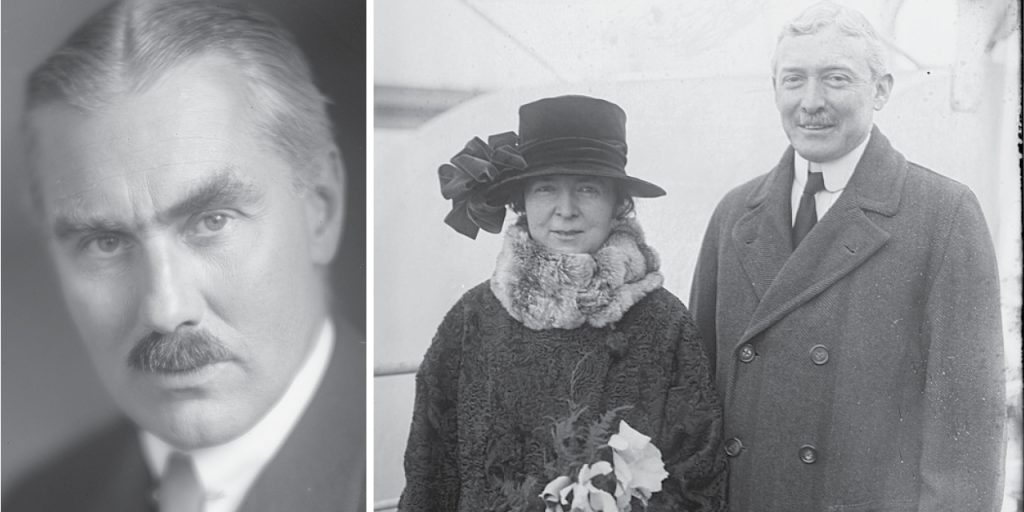
American diplomat Joseph Clark Grew (1880–1965) held posts at US embassies and later became Under Secretary of State and supervised the establishment of the Foreign Service.
Grew’s first diplomatic contact as the American delegate with Türkiye began at the Lausanne conference, where Türkiye and the US signed a treaty of commerce and amity on August 6, 1923. This treaty also provided assurances for Americans’ cultural and religious rights in Türkiye. Again, the treaty decided that countries should cooperate to extradite criminals (iade-i mucrimin). Grew signed this treaty on behalf of the US, İsmet Pasha, Hasan Hüsnü Saka, and Rıza Nur on behalf of Türkiye. He was appointed as US Ambassador to Türkiye in 1927 based on his expertise in Turkish American relations.
The issue of American schools in Türkiye became a crisis in Turkish-American relations during his time in Ankara. A small institution, the Bursa American Girls’ School operated since1876, became a hot topic in the Turkish press in 1928 when newspapers reported that religious propaganda was being conducted at the school and that some students were becoming Christians under the influence of their teachers. After this incident, the school was closed.
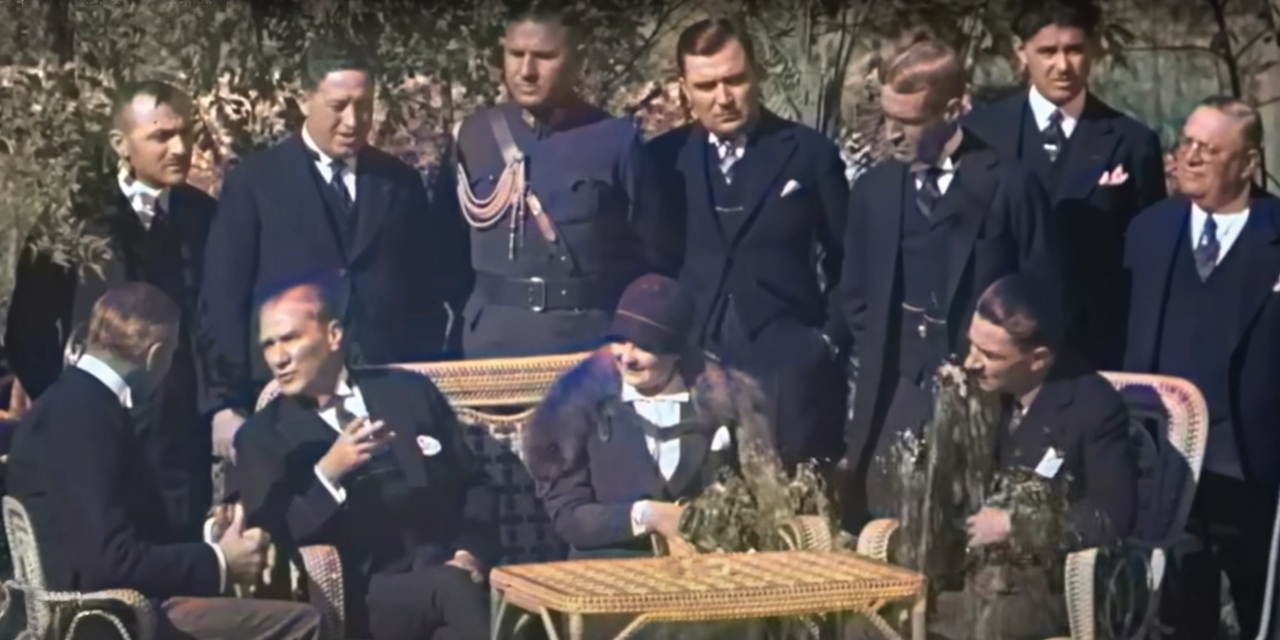
There is an interesting documentary filmed from this era when Atatürk received the US Ambassador position at the Forest Farm in 1930. The event was filmed with a silent camera by Fox. The two surviving archival versions of this film show how Atatürk used film to communicate his and Türkiye’s new image to the American public. 4
The sound recording was done separately. At Mustafa Kemal’s insight and insistence that one day it will be dubbed with the onsite recording when technically possible, it was filmed to look like a sound film with speeches, and it is now available as such.5
Charles Hitchcock Sherrill Era
First published in an article6 prepared by researcher and writer Rıfat N Bali, we learn about Atatürk’s view of Islam, which has always been the subject of speculation, from his own words, through a never-before-published document: American Ambassador General Charles H. Sherrill (1867-1936), who wrote a biography about Atatürk,7 conducted long interviews with him, but did not include some of his words in the book. He expressed this with the lines, “It would not be right to include everything he said about his personal views on religion here.” However, Sherrill did not forget that a diplomat and historian is responsible for history and included the “objectionable section” in detail in the report he sent to the US State Department, thus attributing it to history.
In his book, he writes, “A race that produces great men is great. There is no better way and method to understand a nation than to examine its leader. The Turks have rarely produced a great and meritorious man like Mustafa Kemal, a superior statesperson today. Therefore, the best way to examine Türkiye and the Turks is to start with the political people who govern the country and to examine the savior, pioneer, national hero, and international statesman, the president.”
It was General Charles Sherrill who, as a former US Ambassador to Ankara, noted after Kemal Atatürk’s passing on November 10, 1938, “It should not be forgotten that Kemal showed brilliant strategic ability at Dumlupınar and was able to make the most of the Turkish forces that were far fewer than the enemy…Rarely have invading armies in the world faced such a defeat as the great defeat suffered by the Greeks… He won Lausanne; the first victory that old Asia has given to Europe in the last two hundred years.” ■
……………………..
NOTES:
- Gillespie, Julian Edgeworth (1893–1939) also served as economic and financial advisor to American observers at the Allied and Turkish Peace Conference, Lausanne, Switzerland, in 1922 and 1923, as American delegate to the International Economic Conference, Geneva, May to June 1927, and delegate to negotiate a treaty of commerce and navigation between Türkiye and the United States in 1929. Gillespie married Adrian Inez Posey on March 20, 1924; they had three children. He died of a heart attack on June 23, 1939, in Istanbul, Türkiye, and was buried in Arlington National Cemetery.
- Özkan, K. (2016). Milli mücadele dönemi Türkiye-ABD ilişkileri 1918-1923. İstanbul: Ötüken Yayıncılık.
- Şimşir, Bilal N. Reestablishment of Relations and Ahmet Muhtar Bey’s Embassy in Washington
- Images of Atatürk and US Ambassador Joseph C. Grew at the Atatürk Forest Farm on November 11, 1930, and Atatürk’s speech.
Atatürk’ün Amerikan Büyükelçisi Joseph C. Grew’u Orman Çiftliğinde Kabulü. Turkish Film & TV Institute, 35 mm. Nitrate Film, 1930, 9.40 min.
Fox Movietone News Collections, Moving Image Research Collections, University of South Carolina, B&W Sound, November 1, 1930, Ankara, Türkiye, 13.53 min. - 1930 – Atatürk Ve Afet İnan Atatürk Orman Çiftliği’nde (dubbed in Turkish)
Mustafa Kemal: “Amerika kadınlığını takdir ederim, çünkü siyasi haklarını tamamen kazanmışlardır. Türk kadınları da şimdiye kadar aldıkları haklarıyla iktifa etmeyeceklerdir. Pek yakında mebus intihap etmek ve intihap olunmak hakkını kazanacaklarına ümidim vardır, eminim.”
[Translation} I admire American women because they have fully gained their political rights. Turkish women will not be content with the rights they have gained so far. I am hopeful that they will soon gain the right to choose and be elected as deputies, I am sure.
Mustafa Kemal speaks French.
[translation to English]
Mustafa Kemal: Your Excellency are you happy with what you see here this year?
Ambassador Grew: Now, I have noticed great progress since I saw the farm three years ago.
Mustafa Kemal: It is only five years since we started working here. Before, it was an utterly marshy land. It is mainly Tahsin Bey who works here, surveys, and supervises, right? Do you want me to introduce you to him?
Ambassador Grew: Please, Your Excellency.
Mustafa Kemal: Tahsin Bey! - Atatürk’ün dine bakisi
- A Year’s Embassy to Mustafa Kemal, Charles Scribner’s Sons, New York, Londra, 1934, s. 199-203
……………………..
NEXT ISSUE
American Diplomats to
Mustafa Kemal’s Angora | Part 2
Robert Peet Skinner
(October 16, 1933 – January 16, 1936)
John Van Antwerp MacMurray
(March 16, 1936 – November 28, 1941)
OCTOBER 17, 1933—Atatürk accepted letters of credence from American Ambassador Robert Skinner. Read Atatürk’s response to the Ambassador’s speech at his reception ceremony:
Esteemed Ambassador!
I read with great pleasure the letters of the esteemed President of the United States appointing you as an extraordinary representative and ambassador. I have also received the letter informing me that they have recalled the previous one.
I particularly praise your words expressing your desire to strengthen the existing friendly relations between our two countries for every reason and your statement that you will continue the valuable work done by the previous esteemed ambassador on this path.
You can trust that the sincere feelings you have shown correspond to the friendly feelings my country has always had Toward the great American Republic.
I was deeply touched by the congratulations and wishes sent to me by the honorable President of the United States on the occasion of the 10th anniversary of our republic. I would like to thank them for their kindness and attention.
Türkiye, which established the Republic after a grueling struggle and with great sacrifices, praises the American nation, which waged glorious struggles under the ingenious leadership of its patriotic leaders for its liberation and demonstrated its high patriotism and heroism to the world.
I was very pleased with your words about the deep interest shown by the citizens of your great republic in the innovative movements we are trying to realize in our country.
We are following with interest and attention the applications of the honorable President of the United States toward the economic development of our country. We sincerely and wholeheartedly wish these applications to be successful.
I would like to trust that you will receive both my support and the support of the Government of the Republic in the performance of your duty.
Source: Hâkimiyet-i Milliye /National Sovereignty Newspaper 17.10.1933