US-Turkish relations have long been shaped by arms deals, embargoes, and political maneuvering.
By Mehmet Ali Munir
Today US-Turkish relations pivot on arms sales, declared or undeclared embargoes, unanswered requests, US Senate and House vetoes, blockages at Commission level, sanctions behind the scene, or blatantly open undertakings to unstabilize Türkiye militarily, politically, and economically. In truth there is nothing new under the sun.
Seyr-i Sefâin Treaty of 1830
Requests, embargoes, and Ottoman-American relations started upon arrival of American merchant ships to Izmir port in 1797. Since an official treaty did not exist between the Ottoman Empire and American government, the first arrival of American evangelical missioners to the Ottoman Empire in 1820 were charged in the security of British Consulate.
It took another thirty-three years for the first formal American-Ottoman treaty of commerce and navigation (Türk-Amerikan Dostluk, Ticaret ve Seyr-i Sefâin anlaşması) to be ratified on May 7, 1830, 295 years ago.
Accordingly, American merchants would be able to freely pass through the Straits to the Black Sea; no more taxes would be demanded from them than those collected from other countries; and American businessmen doing business in Ottoman territory would be able to benefit from all kinds of privileges and exemptions.
Beyond commerce with this treaty Americans started to give the citizenship right to predominantly Armenians and taking them under its protection. The Treaty of 1930 also enabled the American Board of Commissioners for Foreign Missions a home-based protection to spread Evangelist movement.
On the trade side the interest was low, and the capacity was never as great or important compared to British, French, and German activities. This will change with the Empire’s Tanzîmât/Reorganization reform starting with the Gülhane Edict in 1839. The purpose was not for radical transformation, but for modernization, primarily a military one, simultaneously taking hold in Japan, Russia, and Egypt.
The 1830 Treaty also included a secret item relating to the securing of American ship building technology, which caused some political friction when the US Senate refused to approve it using an excuse of Washington’s disinterest in getting entangled in the Greek War for Independence (1821–1829) from the Ottoman Turks.
When the Ottoman Navy was destroyed in Navarino by the British, French, and German navies in 1827, the need to build a new navy was crucially important. Of the 52 ships lost during the Battle of Navarino in the Ottoman Navy, 3 were galleons, 12 were frigates, 18 were corvettes, and 4 were brigs. Ottomans were busy laying keels for new hulls at four shipyards in Istanbul and along the Anatolian coast. However, building a navy to early 19th-century standards, the round-hulled, broadside gunships of the North Atlantic was a design not native to the Mediterranean.
A solution was found when a group of businessmen, including America’s premier shipbuilder Scottish-born Henry Eckford was indicted by a grand jury in New York for fraud amounting to several million dollars. Eckford became not only available for foreign hire, but the US Senate veto was bypassed using his private enterprise. His expertise made him an ideal choice to run any shipyard, just when the Ottoman Empire was seeking special talent like his.
“Eckford’s secret to maximum speed appears to have been the prefabrication of a complete set of frames in modern shops on the New York City waterfront, after which assembly could proceed on site almost by the numbers.” 1
In the 1820s, American shipyards began to build ships for foreign navies2 and Eckford, was part of this trend.
Eckford left New York during the first few days of June 1831 and arrived in Istanbul some two months later, near mid-August, on board a new, 1,000-ton corvette named the United States. He sailed there from his own shipyard with intention to sell her abroad, which quickly materialized when the sultan, Mahmud II, bought the 26-gun corvette for a reported $150,000 and renamed it Mesir-i Ferah.
Among those on the ship, there was construction engineer, Forster Rhodes, who was close to the ship’s engineer, and other people with knowledge and experience in shipbuilding.
After the Americans arrived, it was decided to develop ship industries with the idea of building steam engines, wheels, and a rolling mill at The Imperial Arsenal (Tersâne-i Âmire) located on the shores of Golden Horn in 1832.
“The American part of the [shipyard] establishment, entirely under American control and American regulations, and over which the Turks exercise no authority, occupied a space as large as the Navy Yard at Washington” 3
Upon the request of Mahmud II, Forster Rhodes was given important duties in return for a large allocation. The shipyard gained new vitality. However, when Eckford fell ill and possibly died during a cholera outbreak in 1832, the work was interrupted leaving behind two senior Americans: Charles Ross, at the relatively modern Aynalikavak Yards, and Foster Rhodes, Eckford’s longtime assistant, to make the greatest contribution, remaining in Istanbul until 1840.
The first ship built by Rhodes was the Neveser (1834) followed by the Nusretiye galleon, and the Tarz-Cedit a year later. The Nizamiye frigate, the Kafs-ı Zafer brig, and the Müjderesan were commissioned a year later. These were all sailing warships built in the old style, made of wood.

Give Me Guns or Give Me Freedom
The second trade phase began in the 1860s. With the “Ottoman-American Seafaring and Trade Agreement” renewed on February 13, 1862, searches for arms trade gained momentum.
Facing open hostility, reluctance, and arms embargoes the State entertained the idea of securing arms from the US. Edouard Blak Bey (1824–1895) was the first minister of the Ottoman Empire to the United States in 1866 and was primarily assigned for military purchases.
The Ottomans were using muzzle loading technology in the rifles they manufactured in the gun shop affiliated with the Imperial Tophane. As of 1865, Europe and America took a more advanced stage in rifle technology with interchangeable parts and began to manufacture rifles by loading from the breech.
After Blak Bey’s earlier research in Europe, the Ottoman State received an offer from American authorities to negotiate for the sale of the rifles they had. After the ending of the US Civil War (1861-1865), they had a large amount of the 1853 bolt-action British Empire rifle-musket used by troops on both sides and the homemade .58 Springfield named after its original place of production, in Massachusetts. The Ottomans provided an opportunity and acquired many of those weapons without waiting for the manufacturing process since they were fighting intensely during these periods.
In 1869, with the approval of the American Senate, an agreement was reached with the American state for the purchase of 114,000 Enfield brand and 125,000 Springfield brand rifles for a total of 1,351,442 dollars.4
The appearance of Blak in a photograph with Robert E. Lee and other officials from the US government stems from this interest.
See info >
The Cherry on the Cake: Ottoman-Turkish Cruiser Mecidiye (1903)
The Ottoman Navy Mecidiye was a protected cruiser ordered as part of the 1900 large naval modernization program and was built in the US. Her sister ship, Hamidiye, was built at the same time in UK, on the very same specifications.
During the uprising and in 1895-1896, property belonging to United States citizens received damage, resulting in a demand by the White House for a symbolic compensation of 22,000 gold liras from the Ottoman government. After refusing to pay, the US threatenened to send the US Navy to Istanbul to obtain payment. Through the diplomatic channels, there was a settlement to order a much-needed cruiser for the Navy, to be built in USA, as part of the deal by integrating the compensation in the cost.
In November 1899, William Cramp & Son shipyard5 made a proposal, and representing the Empire Ahmet Pasha, sailed himself to the USA for negotiations. The price was reduced from 585,000 gold lira to 300,000 gold lira, while Cramp agreed to pay 100,000 lira as part of the Ottoman property loss payment to US citizens.
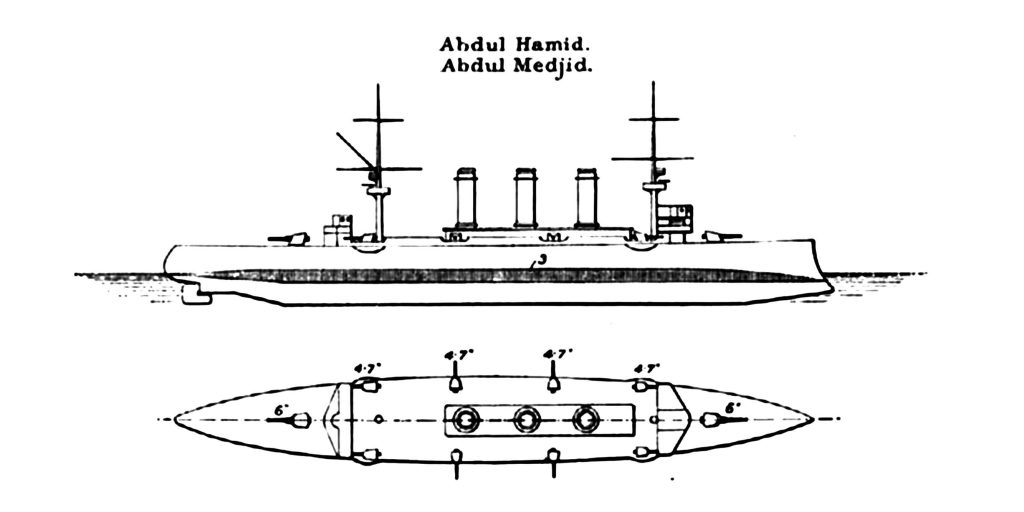
The US government rejected this offer and only after protracted negotiations, a contract was signed in May 1900. However the Ottoman delegates were not happy with the design and started asking for modifications given the rapid change of technological development and delivery of British Armament for commonality with the other Ottoman Royal Navy cruisers.
The keel was laid down eventually on November 7, 1901, at yard number 315, six years after the events, and Mecidiye was built quickly and launched on 25 July 1903, christened by Ottoman delegates, including Şekip Bey the Ambassador to the US.
The relationship with the US went on and survived many turbulent times until today, including issues with F-35 planes and the purchase of F-16s, to name a few. The military-industrial complex still needs to be fed and satisfied in good times and bad. Hell or high water. It happened here, and it will keep happening.