“Wherever I go, I am always impressed by the accomplishments of our Turkish-American citizens—they make us proud every day.”
By Sitki Kazanci
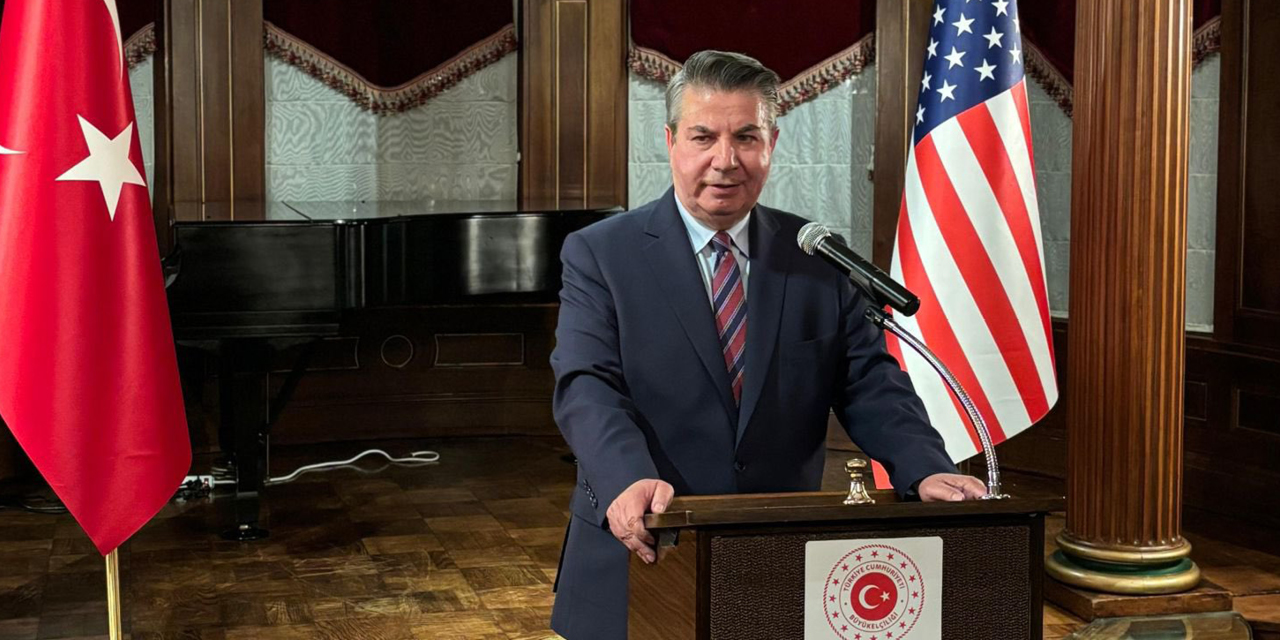
His Excellency Ambassador Sedat Önal, the distinguished representative of Türkiye in the United States, shares his inspiring journey and invaluable insights in this exclusive TurkNetwork Magazine interview. From his early beginnings in Türkiye to a remarkable career spanning over 35 years in diplomacy, Ambassador Önal reflects on the pivotal moments that shaped his professional life. He discusses his priorities in strengthening Turkish-American relations, the challenges and rewards of being a diplomat, and the importance of fostering cultural connections. His deep dedication to representing Türkiye and building bridges between nations is evident throughout his narrative.
You have had a distinguished career in the Foreign Service. How long have you served, and could you tell us about some of the posts and countries where you have worked? What inspired you to pursue a diplomatic career, and what led to your appointment as an ambassador?
Over my 35 year-career as a diplomat, I have had the chance to cover many areas important for the Turkish foreign policy. I have served at our Consulate Generals in Germany, Austria and the United States. In terms of political files, I have mostly dealt with Middle East, having served in countries like Kuwait, Iran, and Jordan, and in various capacities in Ankara from Head of Department to Deputy Minister of Foreign Affairs. Before being assigned as Ambassador to the United States, I served as Permanent Representative of Türkiye to the United Nations in New York. The opportunity and honor of representing my country has always been the most inspiring aspect of my profession.

Among the countries where you have served, is there a particular post that stands out as especially memorable or impactful? What made it unique?
Almost all my assignments have influenced my professional development. My tenure in Kuwait and New York coincided with dramatic events that impacted the trajectory of history. While my assignments in Germany and Austria acquainted me with the multi-dimensional issues related with the Turkish diaspora, my tenure in Iran and Jordan provided me with the opportunity to have first-hand impressions about these countries with which we enjoy deep-rooted relations. I always cherish the precious memories of my interactions with the local people of the countries in which I served.
Last but not least, New York, where I served twice, has a special place in my heart as a big cosmopolite cultural, economic, and intellectual hub.
In your current role, what are the three key priorities you are focusing on to strengthen Turkish-American relations?
We have multidimensional, deep-rooted and time-tested bilateral relations. They continue to flourish based on common values, mutual interests, and shared objectives. We are working hard to contribute to the further development of our relations in every field. In addition to maintaining formal contacts, we focus our efforts on engaging with civil society, business circles, think tanks, academia, and media, as well as fostering closer ties with local authorities in coordination with our Consulates General. Through these efforts, we aim to enhance our cooperation in economy, trade, investments, technology, energy security, counter-terrorism, climate change, defense industry, education, culture, and tourism. We also try to minimize divergences and increase convergences on regional and international issues of common concern.

Many people may not fully understand the responsibilities of an ambassador. Could you share some insights into what a typical day looks like for you in this important role?
Due to the intense and dynamic nature of the Turkish-American relations, I have a busy work schedule. We not only follow and execute our bilateral agenda, but also keep track of developments in many parts of the world that concern both our country and the US.
My daily routine includes keeping myself informed about recent developments in the US, Türkiye, and the world. Throughout the day, I attend meetings and appointments, and my colleagues and I discuss various issues. Representing my country at functions, meetings, conferences, and ceremonies, as well as networking with interlocutors from various areas occupy a significant portion of my daily schedule.
You have been happily married for many years. Could you share how you met Madame Figen Önal and how she has supported you throughout your diplomatic journey?
I met my spouse Figen Çağlayan Önal, who is also a career diplomat, at the Ministry of Foreign Affairs, and I have been fortunate enough to have her by my side all these years. During such a long career it was not always possible for us to be in the same city together, but I have always felt her full support despite distances. Diplomacy is a profession that is based on the concept of representation, which includes all your family and all aspects of your life, official and private. Therefore, the role of the spouse is of paramount importance. If I have a successful career today, it is in no small part thanks to her being always there for me.

Your position must demand a great deal of time and energy. Do you think you managed to find time for hobbies or personal interests? If so, what activities help you unwind and recharge?
Although my busy schedule allows me very little personal time, I try to enjoy art, literature, and music, in particular classical music and jazz, whenever I can. When I was younger I played soccer, but now I am only a soccer fan. My favorite team is Beşiktaş.
What inspires or motivates you the most in your daily life, professionally or personally?
Whatever I do in life, be it professional or personal, I try to make sure that not only the outcome, but the way in which I accomplish it would make me feel content. It is more an innate feeling of responsibility to my own conscience rather than perfectionism, in the strict sense of the word. In my profession, I am lucky to have enduring motivations of serving my people and representing my country.
What is your favorite Turkish dish, and do you have a favorite place to enjoy Turkish cuisine in the United States?
My favorite Turkish dish is “karnıyarık.” Actually, l like all dishes with the ingredients “tomato, green pepper, and eggplant,” as the famous singer/composer Barış Manço makes reference to in one of his popular songs. There are really good Turkish restaurants in the United States and we are fortunate to have many highly rated Turkish restaurants in the DMV area.
You travel extensively across the United States to meet with the Turkish-American community. Are there any success stories from the Turkish-American community you have encountered during your travels that you would like to highlight?
In the seven months that I have been here as Ambassador, beyond the DMV area, I have travelled to New York, New Jersey, Illinois, Michigan, Texas, North Carolina, and South Carolina. I plan to visit California and Florida in the upcoming months. Wherever I go I am always impressed by the accomplishments and successes of our citizens and the Turkish-American community, and it is really difficult to single one out. From Nobel Prize laureates to accomplished artists, scientists, and business people, there are many Turkish-Americans who have excelled in what they do and we are proud of all of them.
Finally, do you have a message or words of encouragement for the Turkish-American community and Turkish businesspeople residing in the United States? How can they contribute to fostering stronger ties between the two countries?
I believe that the Turkish-American community is an essential cultural bridge between Türkiye and the US, constituting one of the most strong and sustainable aspects of our bilateral relations. The increased profile of the Turkish-American community in both local and federal decision-making processes also has positive implications for Türkiye-US cooperation. The more they participate in political life in a unified and organized manner, the stronger their contribution to the improvement of their own socio-economic status, and by extension, to Türkiye-US ties will be. I am happy to see that the majority of Turkish Americans here are to a large extent integrated to the American society while preserving their cultural identity and bonds with Türkiye. We can only be proud of the Turkish-American community and will always stand in solidarity with them. ■