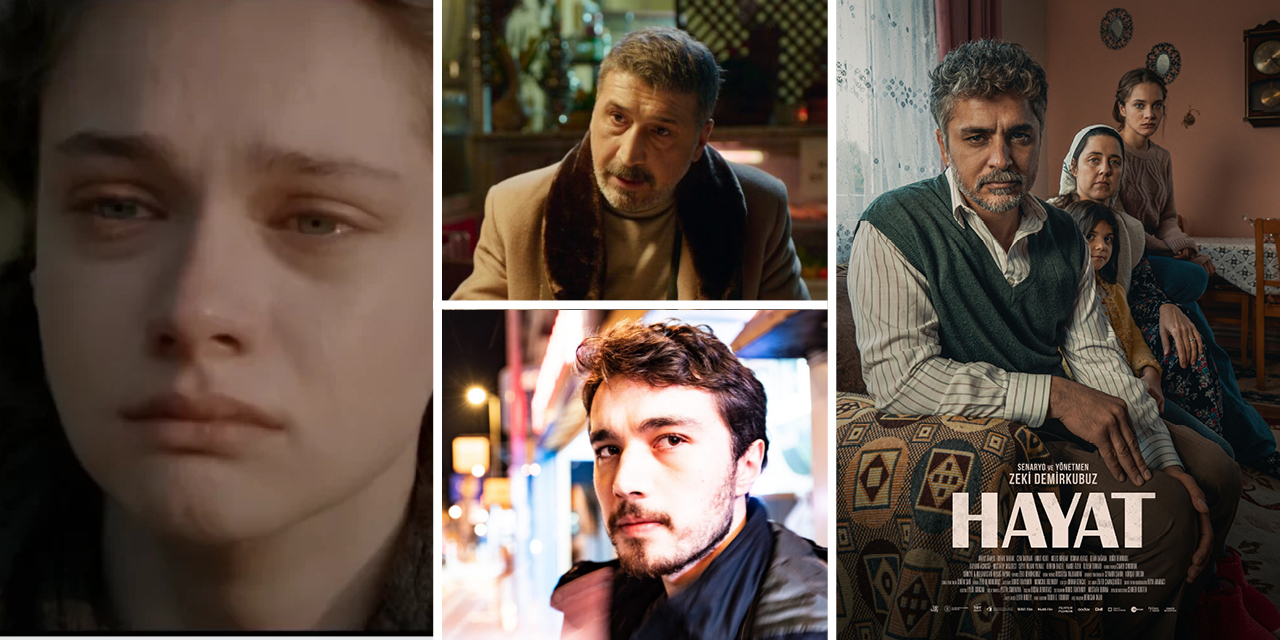
Türkiye’s journey at the Oscars began in 1964 with Dry Summer and continues with Life—a testament to the evolution of Turkish cinema.
“The whole story began 35 years ago during an Anatolian trip to a small border town, when I had a 15-minute interaction with a young woman managing something like a small shop. A girl came out of the door of the grocery store. I was right in front of her, and we were alone. We started looking at each other. We started getting caught up in the situation. We started forgetting everything around us. We forgot about external reality. When I was at the height of my emotions, a bus came, and I got on and went. I remember the girl’s look very well. This is the power of cinema. That little interaction I had with her grew into the story – a young woman trying to live out her dreams in a society dominated by male figures such as a lover, a father, a fiancée, a husband.” –Zeki Demirkubuz
By Ercument Akman
Oscars Time for Life
There were already winners at major film festivals like Berlin, Cannes, Venice, and Toronto with awards in Golden Globes, LA Film Critics, New York Film Critics Circle, and the National Board of Review. We are now leading to the biggest cinematic event known as The Oscars.
The Academy of Motion Picture Arts and Sciences announced the 97th Oscars to take place on Sunday, March 2, 2025, following the shortlists announcement on December 17, 2024.
The first awards ceremony in 1929 had silent films and the Academy had no intention to honor foreign films. The non-English language films category was created in 1956. After the 92nd Academy Awards in 2020, the term “foreign” was seen as outdated to represent global filmmaking, and the new name Best International Feature Film was established that required films not necessarily released in the United States in order to be eligible.
“Life” was Türkiye’s 31st entry beginning in 1964 with Metin Erksan’s “Susuz Yaz/Dry Summer” winner of the Golden Bear in Berlin Film Festival and since 1989 on a regular basis. Tunç Başaran, Nuri Bilge Ceylan, Semih Kaplanoğlu, and Yavuz Turgul have represented Türkiye more than once.
Only in 2008 “Three Monkeys/ Üç Maymun” by Nuri Bilge Ceylan made the shortlist. In 2023 Germany’s entry “The Teacher’s Lounge,” directed by Ilker Çatak, who was born in Berlin to Turkish parents, made that final list.
Other Academy entries partially set in Türkiye with Turkish stories include France’s “Mustang” by Deniz Gamze Ergüven, Germany’s “The Edge of Heaven” by Fatih Akin, Austria’s “For a Moment, Freedom” by Arash T Riahi, and “A Touch of Spice” by Tassos Baulmetis from Greece. Switzerland sent the Cannes co-winner “Yol” and later another film “Journey of Hope” by Xavier Koller about Turkish refugees and won the 1991 Oscar.
Fifteen films advanced to the next round of voting in the International Feature Film category for the 97th Academy Awards. Films from 85 countries and regions were eligible in the category. “Life” was not amongst those films.
Life and Demirkubuz Cinema
Directed by Zeki Demirkubuz, “Life /Hayat,” the 2023 Turkish drama film, was the Turkish entry for the Best International Feature Film at the 97th Academy Awards following Nuri Bilge Ceylan’s “About Dry Grasses/Kuru Otlar Üstüne.”
A was able to see “Life” and “About Dry Grasses” a day apert in Istanbul this August.
They were both impressive films that shared the same cinematographer duo, Kürşat Üresin and Cevahir Şahin, with distinctly different visual flair and atmosphere.
“About Dry Grasses” was the one competing for the Palme d’Or at the Cannes Film Festival winning a best female actor award for Merve Dizdar. Ece Bağcı, who played the student as the character that slandered her teacher Samet delivered a nuanced performance in her first major role.
“Hayat” was made after seven years of silence following “Ember/Kor” (2016), and it still follows his signature themes proven early with “Masumiyet/Innocence” (1997) and “Destiny/Kader” (2006), about regretful, doomed obsessive loves and separations.
“Life” is told in two parts about Rıza and Hicran as the two main characters and rewards the viewer with joy and hope for a different life that makes all tribulations and hurt in the discovery of self while searching the other to be together again.
The universal theme of finding a satisfied end after a slow meditation of 193 minutes of a lovelorn search is the true prize of patience of watching “Life.”
Win or lose this is the first time Demirkubuz was considered for the Turkish entry for an Academy Award nomination. A well-deserved and long overdue recognition of a Master of New Turkish Cinema. He best represents in his filmography a true national character and psyche with themes of sentimental longing and internalized hurt while keeping his cinematic independence by producing under his Mavi production company.
Life is not available for streaming as of this review in North America. “About Dry Grasses” is available on Apple Plus. ■
Find more articles in the oldest blog about Turkish cinema since 2006:
turkfilm.blogspot.com
LIFE
193 minutes
Directed, Written, and Produced by Zeki Demirkubuz
Cast: Miray Daner, Burak Dakak
Cinematography by Cevahir Şahin, Kürşat Üresin
Miray Daner as Hicran; Burak Dakak as Rıza; Umut Kurt as Mehmet; Melis Birkan as Hicran’s mother; Cem Davran as Orhan; Doğu Demirkol as Yılmaz
A Mavi Film (Zeki Demirkubuz) Türkiye, (Rossitsa Valkanova) Bulgaria co-production.
TRAILER
Film director, screenwriter, and producer Zeki Demirkubuz was born in Isparta on October 1, 1964. After completing primary and secondary school in his hometown, he moved to Istanbul.
After dropping out of high school, Demirkubuz worked in a textile workshop and as a street vendor. Following the 1980 coup d’état, he was imprisoned for three years, with alleged activities. Despite this experience, he graduated with a degree in communications at Istanbul University.
The first feature film of Zeki Demirkubuz was “Block-C” (1994). Demirkubuz continued to work as an auteur and independent filmmaker, writing his original screenplays. Critics and international audiences noticed Demirkubuz with “Innocence” (1997), screened at the Venice Film Festival. “The Third Page” (1999) was screened at several festivals in Türkiye and Europe, including Locarno and Rotterdam. Demirkubuz started to work on his trilogy called “Tales of Darkness.” The first two parts, “Fate” (2001) and “Confession” (2001) were screened at Un Certain Regard at Cannes in 2002. Demirkubuz played the leading role in “The Waiting Room” (2003), concluding his trilogy. “Destiny” (2006), the prequel to “Innocence,” “Envy” (2009), was followed by “Inside” (2012), “Nausea” (2015), “Ember” (2016), and “Life” (2023)