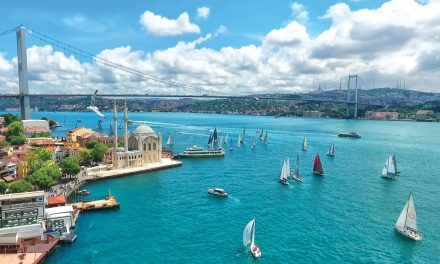
Mehmed II fortified the Anatolian Fortress, partnering it with Rumelihisarı to control Bosphorus traffic and secure victory in 1453.
By Nil Güler
İstanbul’u dinliyorum, gözlerim kapalı;
Önce hafiften bir rüzgâr esiyor;
Yavaş yavaş sallanıyor
Yapraklar, ağaçlarda;
Uzaklarda, çok uzaklarda
Sucuların hiç durmayan çıngırakları;
İstanbul’u dinliyorum, gözlerim kapalı.
Orhan Veli Kanık
Anatolian Fortress: The start of capturing Constantinople
Everything started when Ottoman Sultan Beyazıt built the Anatolian fortress as part of his preparations for a siege on the then-Byzantine city of Constantinople between 1393 and 1394.
It is the oldest surviving Turkish architectural structure built in Istanbul and gives its name to the neighborhood around it in the city’s Beykoz district. Beyazıt’s grandson, Sultan Mehmed II (Fatih) reinforced the fortress. As part of his plans to launch a renewed military campaign to conquer Constantinople, Mehmed II further built a sister structure to Anadoluhisarı across the Bosphorus called Rumelihisarı. The two fortresses worked jointly in 1453 to control all maritime traffic along the Bosphorus, thus helping the Ottomans to conquer the city. The greater municipality of Istanbul has recently renovated Anadolu Hisarı and now serves as a museum.
Yuşa Tepesi (Joshua’s Hill): This is a historical and religious site in Beykoz 180 meters above the sea level and offers stunning views of the Bosphorus and the Black Sea. At the top of the hill is a tomb that is believed to be the grave of Saint Joshua.
Yoros Castle (Yoros Kalesi) is a ruined Byzantine castle in the Beykoz district, north of Joshua’s Hill, which overlooks the Bosphorus and the Black Sea. At present, only the exterior of the upper castle can be visited; entrances to its interior are closed off.
Anadolu Kavagı: A very nostalgic fisherman’s village where you eat freshly cooked fish. It is the end of Bosphorus.

The Maiden’s Tower (Kız Kulesi), also known as Leander’s Tower, existed since the Byzantine period; it is a tower on a small islet at the southern entrance of the Bosphorus strait, 200 m. from the coast of Üsküdar in Istanbul. In the fifth century BCE, a customs point was established on the island where the tower is located today to inspect ships coming from the Black Sea and to collect taxes. There are also many legends about the Maiden Tower. According to one of them, an oracle prophesied that a snake would kill the emperor’s much-beloved daughter on her eighteenth birthday. To protect her, the emperor built a tower on the Bosphorus and locked her up there to keep her away from snakes. But still, when they were carrying grapes to her, a snake hid among them and bit the princess. So here comes the question: “Can you change your fate?”
It is possible to go to the tower by boat from Uskudar Salacak (very close to the tower) and Kabatas (on the European side). The Maiden’s Tower services depart from Uskudar Salacak almost every 15 minutes between 9:00 am and 7:00 pm.
Haydarpasa Train Station is one of Istanbul’s most iconic landmarks. It is on Bosphorus. In 1871 Sultan Abdülaziz ordered the first railway line to be built from Haydarpaşa in Istanbul to İzmit. The architecturally beautiful majestic building was completed in 1909 and was the city’s main train station for many years. I took so many train trips to and from Ankara when I was a student.
Baghdad Railway, a major rail line connecting Haydarpasa with the Persian Gulf, was begun in 1888 by the Ottoman Empire . Financial difficulties and the technical problems of tunneling through the Taurus Mountains made progress extremely slow. Because of its potential strategic importance, work on the line was accelerated after the empire entered World War I . By the end of the war in 1918, the line had been extended from the Haydarpasa station to Nusaybin, which was several hundred miles short of Baghdad. Syria and Iraq eventually completed this remaining stretch and a subsequent extension to the port of Basra,
Prince Islands: They consist of four major and five minor islands. Ordered west to east (also smallest to largest), the major ones are Kınalıada, Burgaz, Heybeliada, and Büyükada. They are closer to Asian Side, and would be a good day-trip especially when you have had enough of the crowd, noise, and traffic of Istanbul. The only way to get there is by sea: You can take Istanbul ferries from the European side either from Beşiktaş, Kabataş or Eminönü. Or on the Asian Side, from Kadıköy, Bostancı, Maltepe, and Kartal. The most frequent departures are from Bostancı. A trip on ferry takes around one-and-a-half hours from the European side, and 45 minutes from the Asian Side. There are also sea bus fast ferries.
On the island there are very beautiful mansions. There is the Church of Saint George (Hagios Giorgios, Aya Yorgi), the Greek orphanage, and House of Trotsky (Leon Trotsky lived here after his exile from the Soviet Union by Stalin).
Transportation on the island is carried out by specially designed electric minibuses with open sides.
Bağdat Avenue (Bağdat Caddesi) is one of the most important high streets on the Anatolian side of Istanbul. It mainly runs through middle and upper-class residential areas. And it is a one-way street for traffic. You can take a dolmuş (minibus) that departs from
Taksim and travels directly to Bagdad Avenue, or you can take the M2 metro line from Taksim Square to the Marmaray train line, which departs and arrives near Bostancı. The fashion trends are closely followed up on Baghdad Avenue and you can come across highly elegant people on this avenue. In Baghdad Avenue, people who love shopping never want to leave because of its luxurious stores, decent cafes, and pleasant atmosphere.
Tuzla: It is the most eastern district of Istanbul. It is one of the moderately populated districts of Istanbul. Türkiye’s largest shipyards are located in Tuzla. Once a summer resort, it is now a maritime education and training center. A historic and famous
Naval Academy (Deniz Harp Okulu), established in 1773, has been training naval officers for the Turkish nation uninterruptedly for more than two hundred years. Tuzla has been a center for many universities like the Maritime Faculty of Istanbul Technical University, Piri Reis University, Sabancı University, and Okan University.