“Life is like a game of cards. The hand you are dealt is determinism;
the way you play it is free will.”
By Melisa Gulsun Ozmen
Do you feel like you have total control over your decisions in your life? Or do you feel like life is an ocean and you are a boat floating in the middle of that ocean, swaying from one side to the other with the flow of waves and the wind? Or do you sometimes feel like one and then the other? The question of whether humans have absolute free will in their lives or not has been a heated debate in fields from philosophy to psychology to social psychology to neuroscience, and is a principal concern of all religions. Neuroscience claims that our decisions are made unconsciously by our brains, and thus free will is an illusion, and social psychology holds that there are so many powerful factors beyond our control that we are not aware of, so there is no room for free will in our decisions. Among philosophers, the determinists posit that all acts of the will have already been determined by preceding events or natural laws, so there is no free will. Of those who reject predeterminism, many also reject free will, arguing that personal choices are random and not determined by an active free will. Yet despite all of these different explanations that deny or discount the importance of free will, science has not totally disproven the existence of free will in humans. In fact, there is good evidence that, to a certain degree, we have free will in our lives.
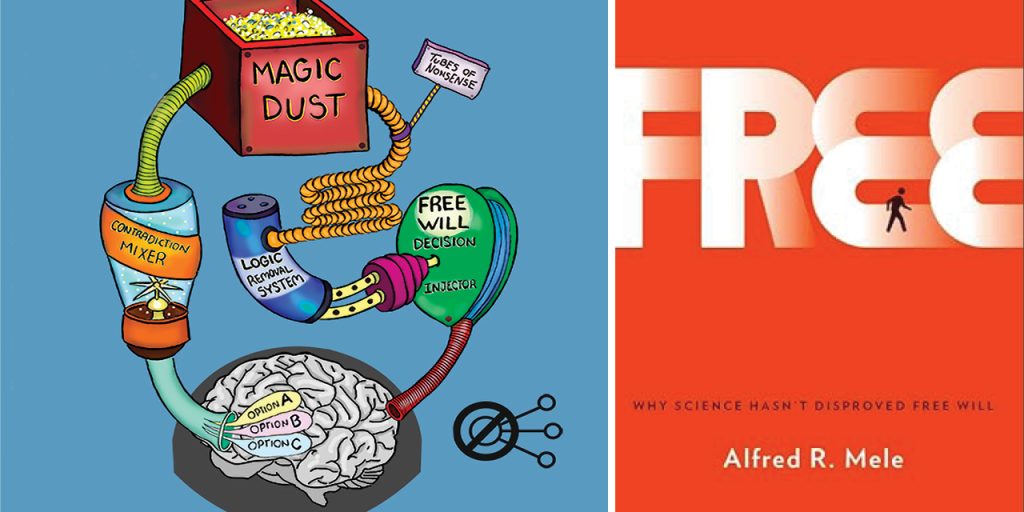
Afred R. Mele, a professor of philosophy at Florida State University has done much research on the topic of free will. In one of his many books on the subject, Free: Why Science Has not Disproved Free Will (2014), he analyzes scientific studies of how believing in the existence of free will or not impacts our decisions in our lives. As people’s confidence in the existence of free will decreases, the incidence of their behaving badly increases. Mele cites a study in Vohs and Schooler (2008) where people who read articles written by scientists denying free will were more likely to cheat on assigned tasks after reading the articles. In another experiment in Baumeister et al. (2009), college students who did not believe in free will behaved more aggressively than students who did. This happens because, as your belief in the existence of free will decreases, your belief that behaving responsibly and accountably will have any effect on the results weakens. Consequently, you simply give up control over your behavior. If you do not take responsibility for your decisions and behavior, you assume nobody can blame you for this failure to take responsibility. But this is only in your imagination. The outside world does not care much about what you think and believe about free will, but instead focuses on the results of your behavior. If you find yourself in jail for your misbehavior, nobody asks you if you believe in free will or not, but only pays attention to the consequences of your misbehavior.
Believing in free will and logical decision making go hand in hand. People who believe in free will are more likely to use logical thinking in their decision-making processes or we can say the opposite as well. People who use logical thinking much in their lives are more likely to believe in free will rather than randomness and pre-determinism. However, logical reasoning requires extensive time, energy, and prior knowledge in order to make decisions. That is why people follow logical thinking only when they have a great deal of time, when the subject to be decided is important and when they have low cognitive load. However, when you do not believe in free will, you do not need to pass through the challenging steps of logical decision-making processes, and you can approach your decisions from a superficial state. In the end, if the decision is the wrong one, you can blame other people involved in your decision, your destiny, the economy, the government, God, or the non-existence of free will in the existence of life for your failed decision.
In Free: Why Science Has not Disproved Free Will, Mele claims that believing in the existence of free will depends on how you understand the term “free will.” With a strict understanding of free will, you might conceive of making conscious decisions using logical thinking methods as totally independent of brain activity or as totally unconstrained by genetics and environment. But both of these are extreme understandings of free will. In real life, you cannot behave consciously and logically all the time because it requires too much time, energy and knowledge, and you cannot isolate yourselves from your genes and the environment you were born into. You have no free will in choosing your family or the country where you were born. And the foundation of your life is the influences you get from your family and the environment you were born into. Therefore, how can we claim that humans have absolute free will if the factors that form your personality and the beginning of your life circumstances are largely predetermined?
Although I sometimes feel total control over my life and sometimes feel like a boat in the middle of ocean, I am a firm believer in free will and mostly use logical reasoning in decision-making processes, but I am also aware of the constraints and boundaries in my life. I know where I have free will and where I do not. I think the secret of free will is being aware of where these differences lie and acting accordingly. Those factors that make you feel like you do not have absolute free will in life may be the ones that ensure your survival and security and keep you alive on this earth. Those factors are the basis of who you are, and they profoundly shape your lives and the decisions you make via your conscious free will. My personal answer to the question of whether we have free will or not would be that there are some areas where we have free will and some areas where we do not. As sentient beings, we can use the power of logic to distinguish those areas and to exercise free will in those areas where we can. ■
……………….
Melisa Gulsun Ozmen is an economics graduate with two decades in Turkish business. She relocated to the US in 2018, seeking personal growth. Immersed in a distinct culture, she discovered inner transformation’s paramountcy, inspired by Osho’s wisdom. This revelation led her to the Transformational Life Coaching Program, graduating in 2020 and cementing her life’s purpose. Melisa is a lifelong learner and coach, continuously exploring political science, psychology, and astrology, while also illuminating her journey of self-discovery and enlightenment through perpetual learning. Learn more about Melisa and visit her blog.