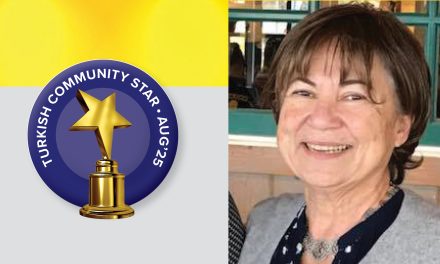
This month, TurkNetwork Magazine proudly features Ergun Kirlikovali as our Community Star, recognizing his unwavering dedication to the Turkish-American community. A pioneering polymer chemist and entrepreneur, Kirlikovali has not only made groundbreaking contributions to aerospace technology but has also been a fearless advocate for Türkiye on the global stage. For decades, he has tirelessly worked to set the historical record straight, counter misinformation, and amplify the voice of Turkish Americans through media, advocacy, and education. His leadership, resilience, and commitment to truth have inspired many, making a lasting impact on both science and community activism. We are honored to celebrate Ergun Kirlikovali as this month’s Community Star.
By Oya Bain
From a curious child in İzmir to a pioneering polymer chemist and passionate advocate, our guest’s journey is one of resilience and determination. With degrees from Boğaziçi University and the University of Manchester, he made groundbreaking contributions to aerospace technology, including the F-35.
Beyond science, he has been a fearless voice for the Turkish American community, challenging misinformation and advocating for Türkiye on the global stage. In this interview, he shares his early influences, career breakthroughs, and unwavering commitment to innovation and truth.
Can you tell us about your early beginnings? Your childhood? Original birthplace? Your parents, siblings?
I was born in Izmir, Türkiye, in 1952. My father was a Forestry Engineer, my mother a housewife, and together they had 8 children, six boys and two girls. I am the youngest of the boys. Below is my photo from when I was 10, sitting on the bike, next to my brother Erhan who was only 16 months older than I. In spite of the age difference, we grew up like twins, same toys, games, friends, and schools.

What factors influenced you most in your formative years?
I was always intrigued by the shiny gift wrappers, glitzy toy packages, and flashy furniture. What were they? They were not paper. Not wood. Not metal. What were they? Later on, I found out that they were plastics. The more I learned about it, the more I liked it. I wanted to study it. That is how I became a polymer chemist.
Your education and training? Where and what did you study?
I went to Kadir Bey Ilkokulu (Primary School) in Bergama, Alsancak Ortaokulu (Junior High School) in Izmir, and Robert Academy (High School) in Istanbul, all located in Türkiye. (This photo is from 1966 at Robert Academy. I am 14 years old and sitting in front of the group.)
Then I got my bachelor’s degree in chemistry from Bogazici University, also in Istanbul, in 1974, and completed my postgrad studies in Polymer science at the University of Manchester in England in 1975. I also had two industrial internships: One in Austria in the summer of 1973 and another in Holland in the summer of 1974, both on polymers. (The photo below was taken in June 2024 at the Bogazici University campus, my alma mater.)

How did you choose your career path?
I can say that it all started with a childish fascination for plastics. When I got accepted to Bogazici University, I knew I had to study chemistry. The two internships in Europe, followed by postgrad work in England, all on polymers, pretty much set me on my path. When I returned to Türkiye, I was full of ideas and excitement. I wanted to do plenty of research and create many new things. I was impatient and determined. Before I could get a job, though, I had to complete my military service. So, I rushed to the recruitment office and got assigned to the Turkish Navy. After four months of training on the island of Yassiada, I became a reserve officer. It was 1977; the US had applied an arms embargo on Türkiye because of Türkiye’s Peace Operation on the island of Cyprus to save Turkish Cypriots from massacres and ethnic cleansing at the hands of Greek Cypriots. Therefore, Türkiye was obtaining most of the military ships and subs from another NATO ally, Germany. Since I was fluent in German, as well as English, I was sent to Germany for two tours of duty. I spent six months each in Kiel and Wilhelmshaven.
After I completed my military service and was honorably discharged, I immediately started looking for a job. Not surprisingly, the very first interview got me a job at an import-export company. There was no job satisfaction. I looked for another job. Again, not surprisingly, the second interview got me my second job at an injection molding company manufacturing auto parts, a boring job requiring no creativity. I started looking for another job. The third interview landed me my third job. It was a fiberglass/polyester components manufacturing factory. Little or no creativity was required. While all this was happening, I was looking for a condo to rent as I was getting ready to marry my Irish fiancée. No one would rent me a place because I was a bachelor. Although the income I was making was rising every time I changed jobs, the amount was still far from covering the rent in a decent neighborhood. Add to that the widespread terrorist acts that claimed the lives of 20-25 young people daily due to polarization and conflict, and shortages of gasoline, coffee, light bulbs, etc., made me rethink my future. Yes, I was very motivated to work in Türkiye, but how was I going to manage? How would I rent a condo that no one will agree to rent to me, a bachelor with insufficient income from an unsatisfactory job, and live happily ever after with my future wife with all this violence and shortages around? Then I finally decided in 1978 to immigrate to the US.

Could you tell us about your journey to the US? What were your initial experiences? What made you settle in the US?
Juliana and I got engaged in August 1977 in Izmir, Türkiye, and married in April 1978 in Dublin, Ireland. Then we flew to San Francisco. It did not take me long to land a job at a polymer company (Adhesive Engineering) where I developed polymer concrete and underwater repair compounds. Three years later, I got a better job offer from an Aerospace Company in Los Angeles (Narmco) manufacturing polymer composites for military aircraft. After a year there, I got an even better job offer from a British multinational (Belzona) in New York. I would be the chief chemist developing do-it-yourself polymer repair compounds for machinery, equipment, buildings, and structures. Needless to say, we had to move from LA to NY. After three years in NY, the desire I was incubating in me for years to start my own business turned into a forest fire. I was 33. It was now or never. I told my wife I was quitting my job, flying back to California, and starting our business. We had some money put away, but it would not last us more than six months, not in California. I had to start making and selling products people could benefit from and would gladly buy. The rest is history.
You are now a well-known, cutting-edge inventor in polymer chemistry who has had great success in defense aviation technology, such as in F-35s. How did that happen?
Back in 1988, we were invited to a bidders’ conference in Palmdale, California, by the aerospace giant Northrop Grumman. They wanted a special material for its B-2 Stealth Bombers that would be “as hard as steel, but also flexible.”
Most engineers and scientists in attendance there thought this was impossible as they were two contradictory requests. After the mid-morning coffee break, quite a few of them left the conference. But there were lightnings flashing in my head. I knew I could do this. There is a reason for this self-confidence. One of my teachers at Manchester University, L.R.G. Treloar, was the person who explained the concept of rubber elasticity to the world in 1942. I was greatly impressed by his teachings, and I knew I could commercialize it one day. That day had finally come.
I worked day and night for six months, completed the formulation and testing, and submitted the material for blind tests. After a few years of extensive testing, my material came out on top and was specified. This success opened the way for Lockheed Martin’s F-35 aircraft. They, too, were looking for very special materials and invited qualified bidders. Again, we passed all the blind tests and got specified. The lesson for the young people here is this: “Do not be intimidated by the prominence and resourcefulness of your competition; stay in the game. If you put your heart and mind to it and work hard at it, you can do it!”
What are your new projects? Do you have any new inventions in polymer chemistry?
We are working on some very smart materials, but I am not at liberty to tell you what they are or how they work. I am sure you can appreciate the confidentiality aspects of our aerospace materials business.
In addition to your impressive career advances, you are one of the most articulate Turkish American leaders who constantly set the historical record straight about the ethnic relations in the Ottoman Empire and modern Türkiye: articles, letters, books, TV programs, tireless efforts, and dangerous encounters. Please tell us what motivated you and what the challenges, trials, and triumphs were.
Three strikes did it for me. Strike One: When I first arrived in the San Francisco Bay Area, I went to a market to buy groceries. I was shocked to read a message on the back of a loaf of bread: “The barbaric Turks killed this baker’s grandparents during WWI.” On a loaf of bread!!! I immediately protested to the store manager and had the entire shelf cleaned of that bread.
Strike Two: A folk dance group from Türkiye visited California to perform colorful Turkish folk dances in several cities. Since I was a folk dancer myself during my college years, I got very excited and bought tickets even for my coworkers. We all went from Foster City to San Francisco in a convoy of cars, only to be met by a police cordon. When we asked why we were not being let into the concert hall, the police officer on duty said an Armenian organization had called and claimed that they had planted a bomb. There was nothing we could do. We drove back home with broken hearts. The disappointment was indescribable.
Strike Three: The Armenian terrorists shot and killed the Turkish Consul General, Kemal Arikan, in broad daylight when Arikan stopped for red lights at Wilshire and Comstock. Then ordinary Armenians at the crime scene interviewed by the media would say things like they do not condone terrorism but that this man deserved it as his government denied the Armenian Genocide. Enough was enough! I called for a press conference at LA Press Club the next morning and told the media the Turkish side of the story. My message was broadcast on all TV and radio channels throughout the day. This not only educated the American public but also electrified the Turkish American community.
This was in 1982. Since then, I have written more than 5,000 letters to media, academia, politicians, think tanks, and other opinion-makers refuting Armenian claims with scholarly evidence, facts, and figures. Armenians leveled countless threats to me and my family. They even declared me the most hated Turk in at least two Armenian hate sites. My answer to them is simple: you created me; now you have to live with me!
What are your recommendations to the younger generation in approaching the baseless ethnic allegations against Tϋrkiye? What do you think are the best methods?
First and foremost, know that the Armenian allegations of genocide are baseless and cannot be supported by historical evidence or international law. Have the self-confidence and courage to reject those racist and dishonest Armenian claims.
Next, know that all the information you need is online. We have websites, YouTube videos, films, books, letters, templates, narratives, and more. All at your fingertips.
I even created a new language for the Turkish American youth born and raised in America, complete with new terms like TERESET, ETHOCIDE, and more. For our youth, I have summarized the entire Turkish-Armenian history under the single letter “T.” “T” as in “Turk.” I call that article The 15 Ts of the Turkish-Armenian Conflict. You can view this in Episode 42 in the www.MythsandRealities.com series. Watch the videos. If you think there is too much information in the series, then simply focus on one of the episodes 39, 40, or 41. They are called “Turkish-American Youth: Here is your response to the alleged Armenian Genocide – Parts 1, 2, and 3.”
What hobbies and activities do you enjoy in your free time?
Traveling, folk dancing, and history reading are my hobbies.
Could you describe your daily routine for us?
I rise very early to beat the traffic. By 5:30 am every day, I am at the office. I prepare for the day, create work orders, respond to emails, and inspect the factory, labs, and so on. After the employees arrive at 8 am, I can go to phase two of my day, meetings with customers, suppliers, and others, usually in our conference room. After lunch, we review production and shipment reports. Employees leave at 3 pm, which is when phase three of my day begins. This is a more relaxed time when I read materials piled in my inbox. I leave work by 5 or 6 pm, pick up dinner on the way home, and sit in front of the TV briefly for the news and commentaries. If there are sports programs, a good TV series, or a new film, I might watch them. By 10 pm, I am usually exhausted and in bed. Weekends are all fun. I try not to bring any work home.
What is your favorite quote?
“Hergün dünden ilerde!” which means “Everyday ahead of yesterday!” This quote was actually the motto of Demirbank in Türkiye in the 1960s. It literally defines me. I must be ahead of the day before by doing something positive every day. I always ask myself at the end of the day, “Am I ahead of yesterday?” If yes, why? If no, again, why? If the answer is yes, though, I sleep like a baby. If the answer is no, my sleep will be miserable.
What is your proudest moment in your life?
When my son got his PhD in chemistry at UCLA.
Who has been the most influential person in your life and why?
This is the simplest question for me to answer: Ataturk, of course! When I was entering those bidding wars with industry giants, my legs were shaking, and I had butterflies in my stomach; I would ask myself, “How big are the risks involved here compared to what Ataturk faced during the Turkish Independence War?” When I realize they are not big at all, I pull the sword from its sheath and jump into the jungle. I have read more than 15 books on him. A soldier, a statesman, a visionary, an innovator, a reader, a writer, a human… He is simply magnificent!

Is there something that the readers of TurkNetwork Magazine might be surprised to learn about you?
I was so fluent in German once that I was a simultaneous translator. But I forgot most of it because I have not spoken a word of it in the last 50 years. As the saying goes, “If you don’t use it, you lose it.”
What are your recommendations to the Turkish American Community? Please feel free to give career and advocacy advice.
Get involved more deeply in American politics. Learn our issues and be an ambassador of Türkiye where you live. Do not be selfish. Give back a little to your community, to your culture, heritage, and homeland Türkiye. Give the best education possible to your children. Be proud to be Turkish!
Would you like to share any message with our readers?
Be a member of your local Turkish American organization and volunteer for tasks. Donate to Turkish causes. Students, make sure to establish a TSA (Turkish Students Association) in your college. Then, network with all other TSAs around the country. Remember, there are close to 20,000 Turkish students from Türkiye, and probably that many more Turkish American youth born and raised here. Can you imagine what a fantastic dynamism they can bring to our communities coast-to-coast? Do not just nod your head; do something about it.
We thank you very much for taking the time to do this interview.
I thank you, Oya Hanim, for giving me this opportunity. You are a great Turkish American who has selflessly given much of your time, money, energy, and love to Turkish American communities in the past 60+ years. I salute you with great respect, admiration, and appreciation. ■